


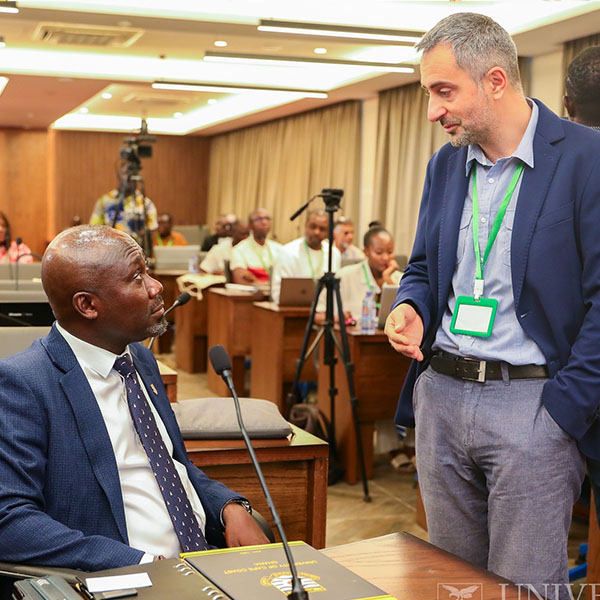
The University of Cape Coast (UCC), in collaboration with the University of Bologna, Italy, has commenced a one-week Advanced Skills Course aimed at strengthening collaboration among higher education institutions across Africa and Europe, reinforcing the role of universities as drivers of sustainable development through knowledge exchange and academic cooperation.
The programme, which began on Monday, brings together participants from universities across both continents to enhance internationalisation, promote regional integration, and deepen institutional partnerships capable of responding to shared global challenges.
Opening the training, the Acting Vice-Chancellor of UCC, Prof. Denis Worlanyo Aheto, underscored the growing importance of global partnerships in contemporary higher education. He stressed that universities can no longer operate in isolation, particularly amid pressing global issues such as climate change, economic instability, and social transformation. According to him, internationalisation has become central to institutional relevance, resilience, and long-term survival.
Prof. Aheto attributed UCC’s consistent ranking as the number one university in Ghana and West Africa to a deliberate strategy that balances local relevance with global engagement. He emphasized that universities must function as global public goods, fostering cross-cultural competencies and knowledge diplomacy to prepare graduates for an increasingly interconnected world.
Presenting on the UNITAFRICA Project, the Project Coordinator, Prof. Sabrina Sorlini of the University of Brescia, explained that the initiative seeks to build a “global village” of scholarship through digital collaboration platforms. She noted that UNITAFRICA promotes staff and student mobility, while also strengthening the capacity of university administrators to effectively manage international partnerships and research grants.
The Rector’s Delegate for Cooperation and Development at the University of Bologna, Prof. Karin Pallaver, highlighted the alignment of the collaboration with Italy’s National Plan for Recovery and Resilience and the Mattei Plan for Africa. She stressed that the partnership is rooted in co-creation of knowledge rather than assistance, with African and European institutions working together as equal partners to address shared global challenges.
Tracing the evolution of the UCC–Bologna collaboration, the Dean of the Office of International Relations at UCC, Prof. Samuel Bert Boadi-Kusi, noted that the partnership, formalised between 2014 and 2017, has grown into a platform for broader Africa–Europe engagement. He added that the programme also strengthens South–South collaboration, bringing together delegates from universities in Kenya, Senegal, South Africa, and Zambia.
The Advanced Skills Course is structured around three thematic areas: international mobility, collaborative research, and university–society engagement. These focus areas are designed to equip participants with practical skills to promote sustainable mobility, equitable research partnerships, and community-centred academic outcomes aligned with the Sustainable Development Goals (SDGs).
Participants are also expected to examine persistent barriers to international collaboration, including visa restrictions and administrative challenges. In response, stakeholders are working toward the development of a UNITAFRICA Charter, intended to provide a long-term framework for cooperation beyond the current funding cycle, which ends in May 2026.
Through this initiative, UCC and its European partners reaffirm the critical role of higher education in advancing inclusive development, global solidarity, and shared solutions to the world’s most urgent challenges.