


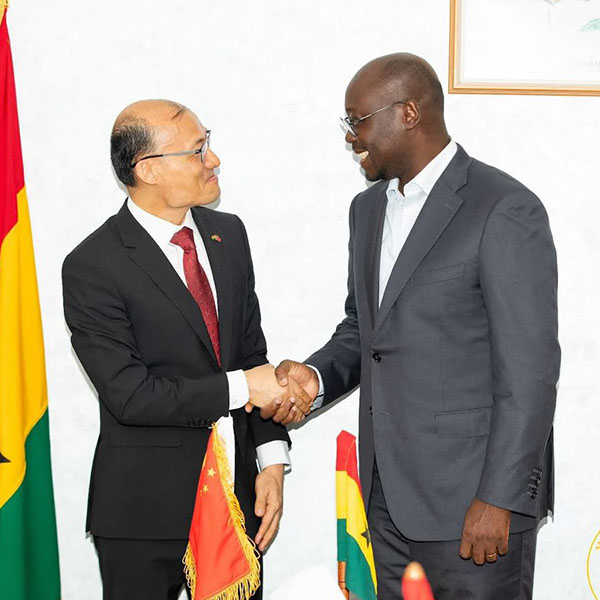
Ghana and China have signed a US$30 million grant agreement to support the construction of a university in Damongo, a move widely seen as a strategic investment in education, regional development, and equitable access to higher learning.
The agreement was signed during a meeting between the Minister for Finance, Dr. Cassiel Ato Forson, and the outgoing Chinese Ambassador to Ghana, H.E. Tong Defa, marking another milestone in the long-standing partnership between the two countries.

Speaking at the signing ceremony, Dr. Forson expressed appreciation to the Ambassador on behalf of President John Dramani Mahama and the people of Ghana, commending his role in strengthening bilateral relations. He noted that although Ambassador Tong’s tenure in Ghana was relatively brief, it coincided with the conclusion of two major grant agreements—funding for a multipurpose market in Aflao and the US$30 million grant for the Damongo university.
The Finance Minister highlighted the broader contribution of Chinese grants and investments to Ghana’s economic and social development, reaffirming Ghana’s deep appreciation for its relationship with China, which dates back to the era of President Kwame Nkrumah and Chairman Mao.

Beyond infrastructure support, Dr. Forson underscored the need to deepen economic cooperation between the two countries by addressing exchange losses associated with bilateral trade. He indicated Ghana’s interest in exploring trade settlements in the Ghanaian cedi and the Chinese RMB, noting that dependence on third-party currencies is inefficient for direct trade partners. He assured the outgoing Ambassador that such discussions would be advanced at the policy level, including engagement with the Bank of Ghana.
For his part, Ambassador Tong Defa expressed gratitude to the Finance Minister for the cooperation and support received during his tour of duty. He congratulated Dr. Forson on Ghana’s improving economic performance and expressed pride in the current state of Ghana–China relations.
The Ambassador noted that he was encouraged by the tangible development outcomes achieved within a short period, particularly in development cooperation, describing the Damongo university project as a testament to the practical benefits of sustained bilateral engagement.
The proposed university is expected to expand access to higher education, stimulate local economic growth, and contribute to human capital development in the Savannah Region and beyond—reinforcing the role of education as a cornerstone of national development.