


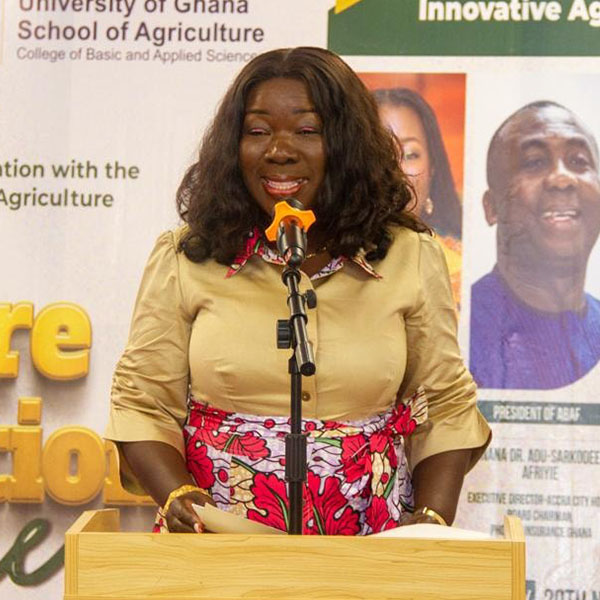
Ghana has reaffirmed its commitment to leading Africa’s agricultural transformation as policymakers, academics and industry experts gathered for the Agriculture Modernisation Conference held Thursday, 20th November 2025, at the Accra City Hotel. The event, themed “Innovative Agricultural Transformation and Sustainable Growth in Africa,” focused on modernising the continent’s food systems through innovation, youth participation and coordinated investment.

Delivering the keynote address, the Minister for Trade, Agribusiness and Industry, Hon. Elizabeth Ofosu-Adjare, outlined Ghana’s bold strategy to position agriculture as a catalyst for economic growth. She highlighted major allocations in the 2026 national budget, including GH¢245 million for the Feed Ghana programme and GH¢200 million for the Ghana Buffer Stock Company, aimed at reducing post-harvest losses, strengthening food security and cutting the nation’s over US 2.5 billion food import bill.
Hon Ofosu-Adjare emphasised the need to link farms to factories and markets through agro-processing, certification and industrial expansion. The Minister also stressed the importance of technology adoption, mechanisation, climate-smart farming, digital platforms, cold-chain systems, and stronger partnerships between academia and industry.

Speaking from a continental perspective, Dr. Forster Boateng underscored Africa’s immense agricultural potential, noting that the continent holds 60 percent of the world’s uncultivated arable land yet imported 97 billion dollars worth of food between 2021 and 2023. He argued that Africa’s youth must be at the centre of the transformation agenda, shifting the perception of farming into a profitable, tech-driven enterprise.
Dr. Boateng outlined six priority areas for rapid agricultural transformation, including transitioning from subsistence farming to market-driven agribusiness, scaling modern technologies such as drones and digital marketplaces, implementing coherent and investment-friendly policies, strengthening collaboration among governments and the private sector, empowering youth agripreneurs through programmes like Ghana’s E-HAPPY initiative, and translating regional visions into actionable national strategies under the AfCFTA.
The conference ended with a unified call for governments, private sector actors, financial institutions, development partners, academia and youth to work together to build resilient, competitive and sustainable agricultural value chains.
Participants expressed confidence that with sustained innovation, targeted investments and coordinated policies, Africa can not only feed itself but also power industrialisation, create jobs and become a global player in agribusiness.