


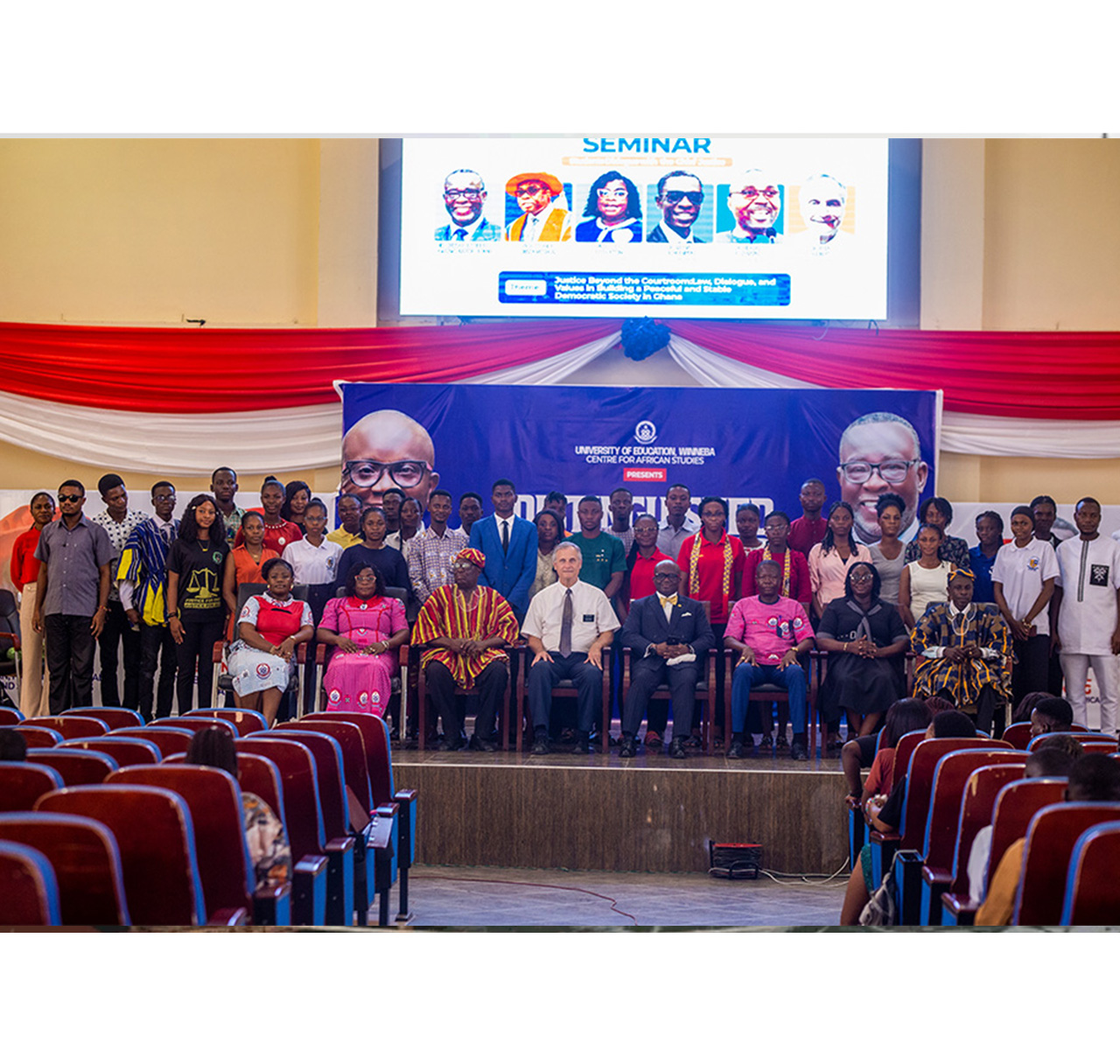
At a time when trust in institutions and civic responsibility are increasingly under scrutiny, the University of Education, Winneba is pushing a powerful message: justice is not only decided in courtrooms—it is lived daily.
Through a high-level dialogue organised by its Centre for African Studies (CAS), the university is challenging students and citizens alike to rethink the role of law, values, and dialogue in sustaining Ghana’s democracy.
Redefining Justice for a New Generation
The seminar, themed “Justice Beyond the Courtroom,” brought together the judiciary, academia, and students to confront a critical question:
What truly sustains a peaceful and stable democracy?
For Frimpong Kaakyire Duku, representing the Vice-Chancellor, the answer lies beyond legal systems. Justice, he noted, is reflected in how people treat one another, how institutions function, and the values passed on to future generations.
His message was clear:
a nation’s strength is rooted not just in its laws—but in its character.
Bridging Theory and National Reality
Organiser Maxwell Acheampong emphasised that the dialogue was designed to connect classroom learning with real-world governance and leadership.
For students, this was more than a seminar—it was a call to action.
A call to:
- Engage critically with national issues
- Understand justice as a lived experience
- Take responsibility for shaping society
Justice Begins with Citizens
According to Lucy Effeh Attom, sustaining Ghana’s reputation as a peaceful democracy depends on citizens who practice fairness, tolerance, and accountability in everyday life.
This shifts the focus from institutions alone to individuals.
Because without responsible citizens, even the strongest systems can fail.
The Judiciary’s Perspective: Dialogue Over Conflict
Delivering the keynote on behalf of the Chief Justice, Kweku Tawiah Ackaah-Boafo of the Supreme Court shared a crucial insight:
the real work of democracy happens outside the courtroom.
While courts remain essential, he stressed that lasting peace is built in homes, schools, and communities—where values are formed and conflicts are resolved through dialogue.
He pointed to initiatives like expanded courts and alternative dispute resolution systems as signs of growing access to justice, but warned that systems alone are not enough.
Citizens must choose dialogue over division.
Education as the Foundation of Peace
Adding an international perspective, Ryan Hulbert highlighted the role of education in shaping free, hopeful, and responsible societies.
He urged educators and future leaders to inspire critical thinking, model integrity, and create environments that nurture responsible citizenship.
Because when education shapes values—not just knowledge—societies thrive.
The Bigger Picture
This dialogue is more than an academic exercise. It is part of a broader effort by the University of Education, Winneba to raise a generation that understands democracy not just as a system of governance—but as a way of life.
If sustained, such conversations could:
- Strengthen civic responsibility
- Promote peaceful conflict resolution
- Deepen trust in democratic processes
CONCLUSION
Ghana’s democracy has long been admired for its stability. But its future will depend not only on courts and constitutions—but on citizens.
The message from UEW is both simple and urgent:
justice must be practiced, not just preached.
The real question now is—
are we ready to live it?