
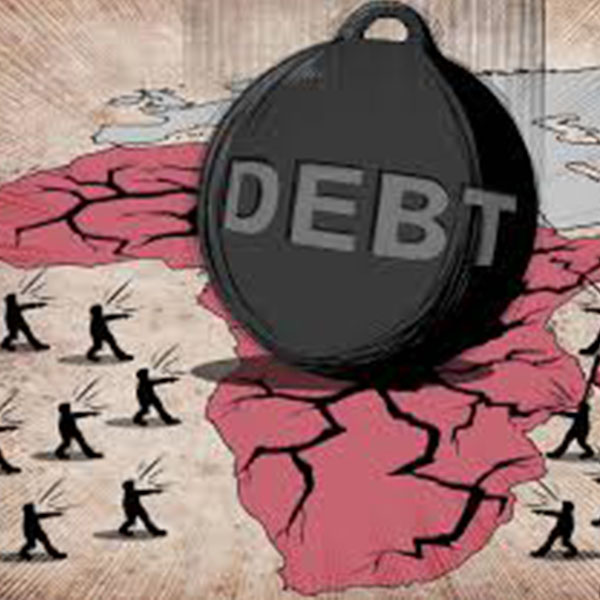
A new analysis has raised urgent concerns about the impact of Africa’s rising public debt and illicit financial flows on households, warning that women and children bear the greatest burden as governments divert funds away from essential public services to repay loans.
The report, developed with support from the Nawi Afrifem Collective, reveals that sub-Saharan Africa’s external debt has surged to 1.8 trillion dollars — an increase of 183 percent since 2010. At the same time, the continent loses an estimated 88.6 billion dollars annually through illicit financial flows, including tax evasion, misinvoicing of exports, corruption and profit shifting by multinational corporations.
Advocacy groups say the combination of unsustainable debt and massive capital leakage is creating a social crisis.
“Forty six African countries are now spending more on servicing debt than on healthcare,” the report notes, warning that the resulting cuts to education, health, agriculture, and social protection are disproportionately affecting women.
Women Paying the Price for Africa’s Debt Burden
Because women make up the majority of caregivers and informal workers, reductions in public spending are forcing them to fill the gap through unpaid labour. With hospitals understaffed, early childhood education underfunded and user fees increasing, women are doing more caregiving at home — losing opportunities for paid work and education.
In countries such as Zimbabwe, Zambia and Tanzania, past austerity programs linked to debt repayment led to lower health and education spending, increased school dropouts, declining nutrition and worsening poverty. The report highlights how such policies have widened gender inequalities and intensified domestic stress.
Illicit Financial Flows Robbing Africa of Critical Revenue
The report emphasizes that illicit financial flows remain one of the biggest threats to development. From 1980 to 2018, Africa lost 1.3 trillion dollars through illicit outflows — nearly double its current total external debt.
Gold alone accounted for 77 percent of illicit outflows from extractive industries in 2015.
Countries with high illicit financial flows are spending significantly less on health and education, worsening inequality. Experts say that stopping illicit flows could generate revenue equal to 3.9 percent of Africa’s GDP, enough to fund nearly half the climate adaptation costs needed by 2030.
Call for Global and National Action
Advocacy groups are urging bold reforms to avert a worsening crisis:
-
A two-year freeze on debt repayments for African countries
-
Fairer and more transparent global lending practices
-
Removal of harsh loan conditionalities that force governments to cut social spending
-
A binding United Nations treaty to hold multinational corporations accountable
-
Stronger regulation of predatory household lending and mobile loan apps
At the national level, the report calls for governments to:
-
Stop the privatization of essential services like health and education
-
Strengthen anti-corruption systems
-
Transform economies away from dependence on raw material exports
-
Scrutinize all new loans through a gender and social equity lens
-
Invest in climate-resilient, small-scale agriculture and agroecology
Debt Cancellation Framed as Reparations, Not Charity
The report also urges African governments and civil society to reframe debt cancellation as reparation for historical exploitation, rather than a plea for charity.
Advocates stress that meaningful debt relief and a crackdown on illicit financial flows are essential for Africa to meet its human development goals, achieve gender equality and build resilient economies.
As the report concludes, “Africa cannot develop while billions of dollars leave the continent each year, while households — especially women — pay the price for debt they did not create.”
attached is the report: 128_Public_debt_and_illicit_financial_flows_in_Africa_and_their_impact_on_African_households_1_4_