


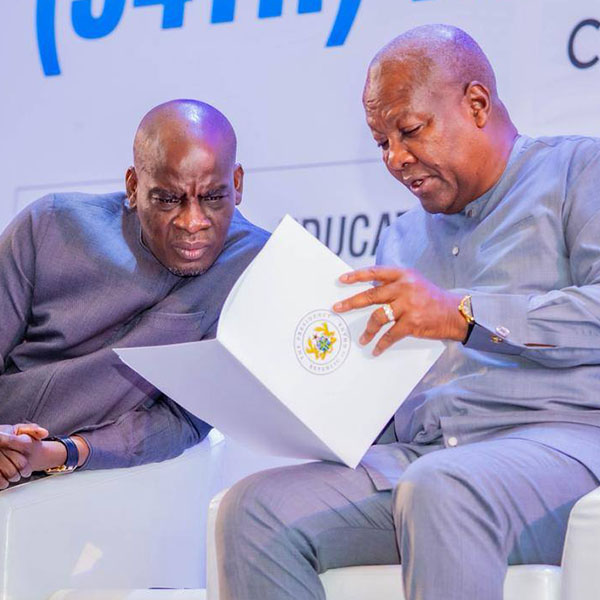
The Minister of Education, Hon. Haruna Iddrisu, has reaffirmed the central role of teachers in Ghana’s national development, describing them as the unseen architects behind every professional, leader, and institution shaping the country today.
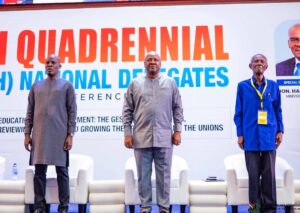
Speaking at the 54th National Delegates Conference of the Ghana National Association of Teachers (GNAT) at the University of Professional Studies, Accra, the Minister, who accompanied President John Dramani Mahama, underscored the enduring impact of teachers as Ghana reflects on five decades of the Ghana Education Service.
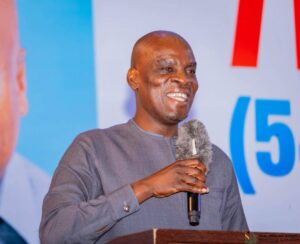
“Every stage of Ghana’s development story carries the fingerprints of a teacher,” Hon. Iddrisu stated, noting that behind every engineer, nurse, farmer, entrepreneur, civil servant, and political leader lies a classroom and a dedicated teacher who laid the foundation.
GNAT as a Pillar of National Education Reform
Hon. Iddrisu acknowledged GNAT not merely as a stakeholder, but as a pillar of Ghana’s education system and a critical partner in reform efforts. He emphasized that sustainable progress in education cannot be achieved through blame or division, but through dialogue, trust, and shared responsibility between government, teachers, and education institutions.
The Ministry of Education, he assured, recognizes the history, strength, and legitimacy of GNAT’s voice and remains committed to working collaboratively to strengthen teaching and learning outcomes nationwide.
WASSCE Results Demand System-Wide Reflection, Not Blame
Drawing attention to the 2025 WASSCE Chief Examiner Reports, Hon. Iddrisu urged teachers and education authorities to use the findings as a tool for collective improvement rather than fault-finding. He encouraged teachers to “up their game” to improve student performance, while stressing that the challenges identified reflect broader systemic gaps that require urgent support.
Across core subjects—English Language, Mathematics, Integrated Science, and Social Studies—the reports revealed a consistent pattern: many students demonstrate basic knowledge of concepts but struggle to apply them in real-life situations, interpret information critically, solve unfamiliar problems, and express ideas clearly and coherently.
In Social Studies, candidates understood concepts but found it difficult to link them to societal issues. In Mathematics, students performed better in procedural questions than in application and interpretation. In English Language, weaknesses in grammar, vocabulary, and expression limited effective communication. In Integrated Science, practical reasoning and scientific application posed significant challenges.
A Call for Better Support, Not Teacher Blame
Hon. Iddrisu was emphatic that these findings should not be seen as an indictment of teachers. Rather, he described them as a clear signal that Ghana’s education system must do more to support teaching for understanding, application, and higher-order thinking.
He advocated for strengthened teacher development, improved teaching resources, and instructional approaches that move beyond rote learning to equip learners with critical thinking, problem-solving, and communication skills needed for the modern world.
Investing in Teachers Is Investing in Ghana’s Future
The Minister’s message resonated strongly with delegates, reinforcing the argument that meaningful education reform begins with empowering teachers. As Ghana seeks to improve learning outcomes and prepare students for national and global competitiveness, sustained investment in teacher capacity, curriculum relevance, and classroom innovation remains non-negotiable.
Ultimately, the address reaffirmed a simple but powerful truth: when teachers are supported, learners thrive—and when learners thrive, Ghana advances.